 Agent
Agent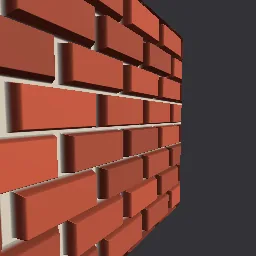
What this component contains
ATTRIBUTION.mdLICENSEREADME.mdcomponent.jsondemo.tscninspect_shader.pymaterial.tresparallax_occlusion_bricks.gdshaderpreview.pngtest_package.pyverification/native.json
How it works
- Shader type
- spatial
- Parameters
- brick_color (vec4 = 0.62, 0.26, 0.18, 1), mortar_color (vec4 = 0.72, 0.7, 0.66, 1), bricks_across (float = 4), bricks_down (float = 8), mortar_width (float = 0.06), bevel (float = 0.08), depth_scale (float = 0.05), steps (int = 24) and 1 more
- Use it on
- A mesh with UVs and tangents (Godot primitive meshes have both).
- Result
- A red brick wall whose mortar lines look recessed and whose bricks occlude each other at angles.
- Renderers
- compatibility: compiled and rendered, forward plus: not verified, mobile: not verified
- Placement
- res://baltor/godot_shaders/parallax_occlusion_bricks/
Recorded checks
godot 4.7.2.stable.official.ed1daf0bf
contract_staticengine_runengine_log_cleanshader_in_scenecapture_writtenrender_not_uniformshader_changes_pixels
Limits to consider
The silhouette stays flat: only the interior of the surface shows depth. Shadows and depth are the flat surface's. Cost grows with `steps`. Strongly curved surfaces bend the illusion. The march runs in UV space, so non-square UV scaling skews the depth.