 Agent
Agent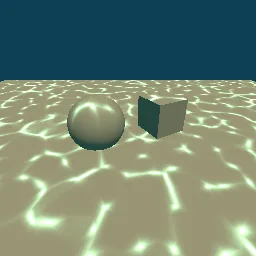
What this component contains
ATTRIBUTION.mdLICENSEREADME.mdcomponent.jsondemo.tscninspect_shader.pymaterial.trespreview.pngtest_package.pyunderwater_caustics.gdshaderverification/native.json
How it works
- Shader type
- spatial
- Parameters
- albedo (vec4 = 0.75, 0.7, 0.55, 1), caustic_color (vec4 = 0.65, 1, 0.95, 1), caustic_scale (float = 1.6), caustic_strength (float = 1.4), sharpness (float = 5), drift_speed (float = 0.25), water_surface_height (float = 2), depth_falloff (float = 0.25) and 1 more
- Result
- Sand-coloured floor and objects covered by a shifting web of bright cyan light lines on their tops.
- Renderers
- compatibility: compiled and rendered, forward plus: not verified, mobile: not verified
- Placement
- res://baltor/godot_shaders/underwater_caustics/
Recorded checks
godot 4.7.2.stable.official.ed1daf0bf
contract_staticengine_runengine_log_cleanshader_in_scenecapture_writtenrender_not_uniformshader_changes_pixels
Limits to consider
A pattern, not light transport: it ignores the real water surface and shadows from objects above. Projected straight down in world space, so vertical walls get none. Emission makes caustics visible even in shade.